Polyaspartic vs. Epoxy Garage Floor: Which One Actually Holds Up in a Washington Garage?
Both are common garage floor systems, and both show up constantly in Washington contractor marketing. Here's what actually separates them, and why it matters for a floor that has to hold up in this state specifically.
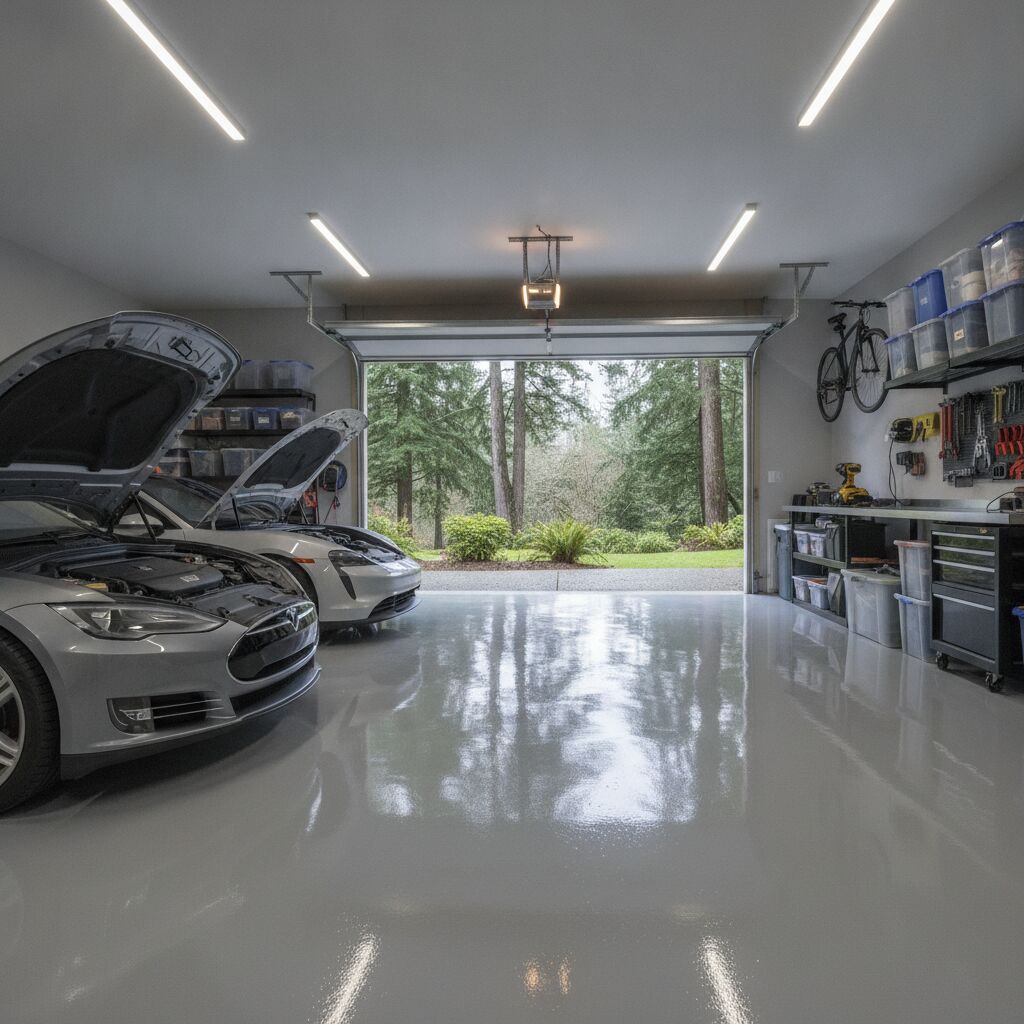
If you've looked into garage floor coating anywhere in Washington, you've probably run into both terms — polyaspartic and epoxy — often used side by side or even interchangeably in contractor marketing. They're not the same thing, and the difference isn't just branding. The chemistry behind each system affects how long installation takes, how the floor performs over years of use, and how well it holds up to Washington's specific installation timelines and climate exposure on both sides of the Cascades.
What epoxy is, and where it came from
Epoxy garage floor coatings have been the standard for decades, and for good reason — they're a well-understood, widely available system that bonds well to properly prepared concrete. Standard epoxy typically has a longer cure schedule than newer systems, often requiring the floor to be out of use for a day or more between coats and before it can handle vehicle traffic again. It also tends to be more sensitive to UV exposure over time, which can lead to yellowing or a chalky surface film on floors that get direct sun through an open garage door for years.
What polyaspartic actually is
Polyaspartic coatings are a fast-cure aliphatic polyurea system, often applied as a durable topcoat over a base coat in a single-day installation. The chemistry cures much faster than standard epoxy — in some cases hours rather than a full day per coat — which is a meaningful practical advantage for anyone who can't take a garage fully out of service for an extended stretch. Polyaspartic topcoats are also generally more UV-stable than standard epoxy, which matters for garages that see direct sunlight, and more flexible across a wider temperature range, which matters for a state that runs from Puget Sound's marine climate to Eastern Washington's real winter freeze-thaw cycling.
- Cure time — polyaspartic systems generally cure much faster than standard epoxy, often allowing single-day installation.
- UV stability — polyaspartic topcoats generally hold color and clarity better under sustained sun exposure than standard epoxy.
- Temperature flexibility — polyaspartic systems are generally formulated to remain stable across a wider temperature range, relevant for Eastern Washington's seasonal swings.
- Installation window — faster cure times make polyaspartic more forgiving of Washington's shorter dry-weather windows, particularly west of the Cascades.
Ready to compare systems for your specific garage?
See our garage floor coating pageWhy Washington's installation timeline matters here specifically
Every coating system needs the right conditions and enough uninterrupted time to cure properly. Western Washington's marine climate doesn't always offer a long stretch of ideal, low-humidity installation weather, and a homeowner or facility that can't take a garage or bay out of commission for an extended multi-day process needs a system that accounts for that reality. Fast-cure polyaspartic chemistry was specifically developed to shrink that installation window without sacrificing durability — which is a big part of why it's increasingly the system Washington contractors reach for over standard epoxy.
Good to know
Not every "polyaspartic" or "polyurea" product on the market performs identically — formulation quality, application thickness, and proper surface preparation all affect real-world results. That's a detail worth discussing on a project-specific basis rather than assuming every coating advertised under either term performs the same.Eastern Washington's freeze-thaw factor
West of the Cascades, UV stability and installation speed tend to be the deciding factors. East of the Cascades, Spokane, the Tri-Cities, and Yakima see genuine winter freeze-thaw cycling that standard epoxy wasn't necessarily engineered to handle gracefully over repeated seasons. A coating that stays flexible across a wider temperature range has a real advantage in a garage that swings between summer heat and winter cold every year. We cover that side of the state's value-conscious market in more detail in our guide to Eastern Washington garage floor coating value and freeze-thaw durability.
So which one should you choose?
There's no single universal answer — it depends on your floor's current condition, how quickly you need the garage back in service, your region of the state, and your finish goals. What's clear is that the difference between polyaspartic and epoxy isn't marketing noise; it's a real chemistry difference with real consequences for how a Washington garage floor performs over years of actual use. Contact us to discuss which system fits your specific garage and timeline.
Quick answers
Is polyaspartic the same thing as polyurea?
They're closely related but not identical — polyaspartic is a specific type of aliphatic polyurea coating, often used as a fast-cure topcoat. In everyday marketing, the terms get used somewhat interchangeably, but the underlying chemistry can vary between systems. Contact us to discuss which specific system fits your project.
Can epoxy be a fine choice for a Washington garage?
Standard epoxy can work for a garage that sees light use and a controlled installation timeline, but its longer cure schedule and generally lower UV and moisture tolerance make it a harder fit for Washington's shorter dry windows and either coastal or freeze-thaw exposure, depending on region.
How do I know which system is right for my garage?
It depends on your floor's current condition, your timeline, your region of the state, and your finish goals. Contact us for a project-specific assessment before assuming either system is automatically the right call.
Ready to compare systems for your garage?
Contact us for a project-specific estimate on the right coating system for your garage. Call 844-967-5247 or get started online.
More from the blog
Marine & Industrial
Why Puget Sound's Salt Air Is Quietly Damaging Untreated Concrete Floors
Read moreBuilding Code & Compliance
What Washington's Building Code Actually Requires for Concrete Vapor Barriers (WAC 51-11R-40241)
Read moreCommercial & Tech Campus
Data Centers, Biotech Labs, and Corporate Campuses: Seattle's Flooring Market Most Contractors Ignore
Read more