Why Puget Sound's Salt Air Is Quietly Damaging Untreated Concrete Floors
If your facility sits anywhere near Puget Sound — a port warehouse, a ferry terminal building, a marine-adjacent logistics yard — the concrete underfoot is dealing with an exposure most of the country never has to think about.
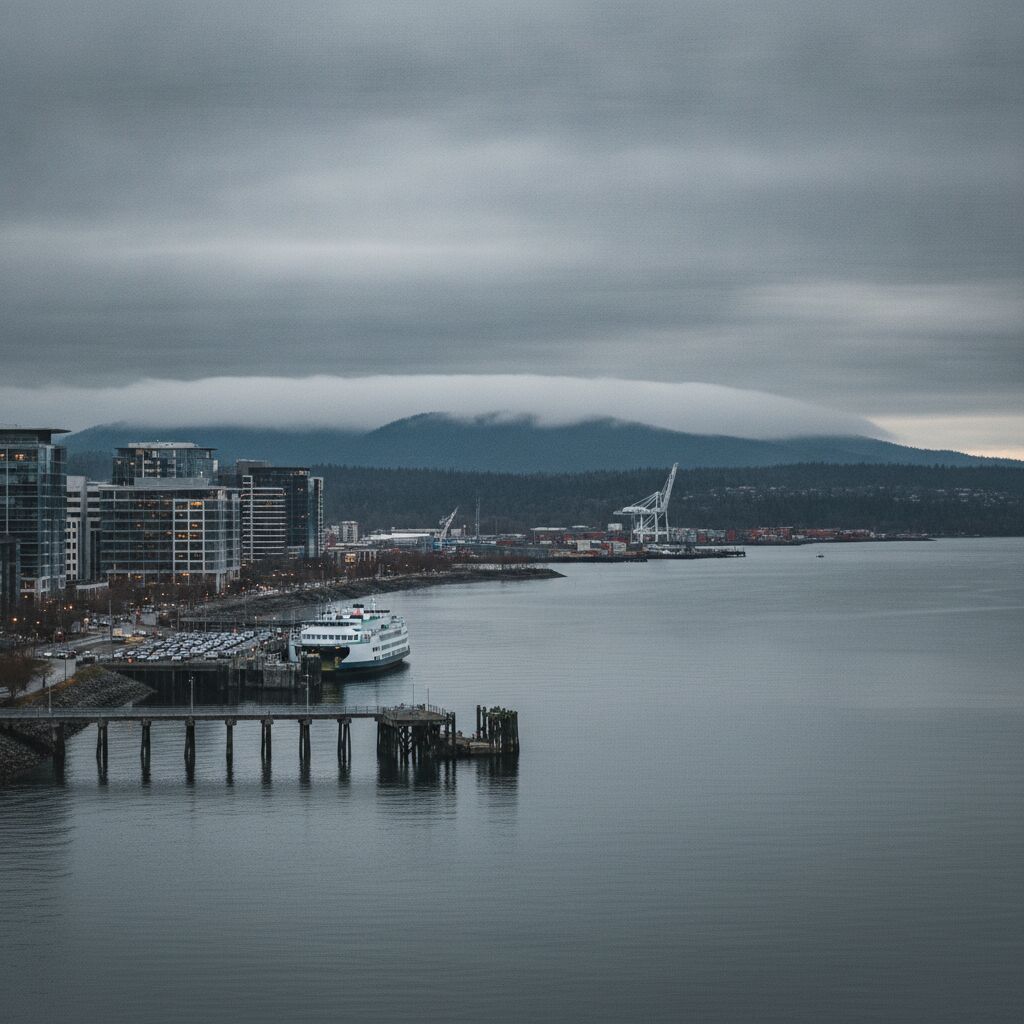
Washington runs one of the largest working marine-industrial waterfronts in the country. The Port of Seattle and the Port of Tacoma operate jointly as the Northwest Seaport Alliance, one of the largest container-port complexes in North America, and Washington State Ferries — the largest ferry system in the United States by ridership — keeps terminal buildings and maintenance facilities running up and down the Sound. Every one of those facilities has concrete floors, and every one of those floors sits inside a saltwater-adjacent air environment that inland concrete in most of the country simply never experiences. That exposure has a real, named effect on concrete and the metal embedded in it, and it's worth understanding before it shows up as a maintenance problem.
The mechanism: chloride ingress, not moisture load
It's easy to lump "being near the water" in with general Pacific Northwest dampness, but they're not the same problem. Ambient humidity and rain drive moisture-vapor-transmission issues from inside a slab pushing outward. Salt-air exposure is a different, chemical mechanism: airborne chloride ions from saltwater spray and salt-laden air settle on and gradually penetrate concrete surfaces. Concrete itself is somewhat porous, and unprotected slabs can absorb chloride over time. Once chloride ions reach embedded rebar or metal anchors and fixtures, they break down the passive protective layer that normally keeps steel from corroding — and once that layer is compromised, corrosion can proceed steadily, even inside a slab that looks fine on the surface.
Why this matters more for some facilities than others
Not every building in Washington needs to think hard about chloride exposure — this is specifically a concern for facilities that are near open water, exposed to salt-laden wind, or exposed to de-icing and road-salt runoff during winter months. That describes a real and specific set of Washington properties:
- Port warehouses and logistics facilities in the Port of Seattle and Port of Tacoma corridor
- Ferry terminal buildings and maintenance facilities around Puget Sound
- Marine-adjacent industrial and manufacturing buildings near shoreline or tidal-influenced sites
- Facilities with loading docks or drive lanes exposed to winter de-icing salt or salt-laden runoff
If your facility fits one of these profiles, the concrete floor is doing more work than it looks like — and a standard, unprotected slab or a generic coating not formulated for chloride resistance isn't necessarily giving that floor the protection it actually needs.
Managing a port, ferry-adjacent, or marine-industrial facility around Puget Sound?
See our marine-industrial flooring pageWhat a chloride-resistant coating system actually does
A properly specified chloride-resistant polyurea coating works by creating a dense, non-porous barrier over the concrete surface — one designed specifically to keep chloride ions from penetrating into the slab and reaching embedded steel in the first place. That's a materially different design goal than a standard decorative or light-duty coating, which may hold up fine cosmetically while offering little real resistance to chloride penetration over years of salt-air exposure. Fast-cure polyurea chemistry is also a practical advantage for these facilities specifically, since port and ferry-terminal buildings often can't fully shut down for an extended installation window.
Good to know
Chloride exposure is cumulative and often invisible until corrosion has already started on embedded steel — by the time visible cracking or rust staining shows up on the surface, the underlying damage may already be significant. That's part of why proactive protection on new or recently-resurfaced slabs is worth taking seriously for marine-adjacent facilities, rather than waiting for visible symptoms.How this is different from Washington's moisture-vapor-barrier story
It's worth being precise here, because the two issues get conflated. Washington does have real, code-relevant moisture-vapor-transmission requirements for concrete slabs — covered under the state's own building code — and that's a genuinely important, separate topic for slab preparation statewide. But salt/chloride corrosion resistance is a distinct technical requirement specific to marine-adjacent and de-icing-salt-exposed sites, not a general Pacific Northwest "wet climate" issue. A facility near Puget Sound may need both a moisture-vapor-aware installation approach and a chloride-resistant topcoat — they solve different problems, and treating them as the same thing risks leaving one of them unaddressed.
What to look for if you manage a marine-adjacent facility
If you manage a warehouse, terminal building, or industrial facility anywhere near Puget Sound's working waterfront, it's worth having a conversation about your floor's actual exposure profile before assuming a standard coating system is adequate. Distance from the water, prevailing wind direction, whether the site handles de-icing operations in winter, and the age and condition of the existing slab all factor into what system makes sense for a given building. Contact us for a project-specific assessment of your facility's exposure and what a chloride-resistant coating system would involve.
Quick answers
Can concrete really be damaged by salt air near the water?
Yes. Airborne salt and chloride exposure near Puget Sound can work its way into concrete over time and accelerate corrosion of embedded rebar and metal fixtures. Non-porous, chloride-resistant coating systems are formulated specifically to slow that process by keeping chloride ions from reaching the reinforcing steel in the first place.
Is this the same thing as a coating for rain or humidity?
No — it's a different mechanism entirely. Rain and humidity drive moisture-vapor-transmission issues from within a slab; salt/chloride exposure is a chemical attack on embedded metal that comes from airborne exposure near saltwater. A facility near Puget Sound can face both, but they call for different technical approaches.
Do I need a chloride-resistant coating if my facility isn't directly on the water?
It depends on proximity, prevailing winds, and whether the site also sees de-icing salt or road-salt runoff exposure. Contact us to discuss your facility's specific location and exposure profile — the right system depends on the details.
Managing a facility near Puget Sound's working waterfront?
Contact us for a project-specific estimate on chloride-resistant flooring. Call 844-967-5247 or get started online.
More from the blog
Garage Floor Coating
Polyaspartic vs. Epoxy Garage Floor: Which One Actually Holds Up in a Washington Garage?
Read moreBuilding Code & Compliance
What Washington's Building Code Actually Requires for Concrete Vapor Barriers (WAC 51-11R-40241)
Read moreCommercial & Tech Campus
Data Centers, Biotech Labs, and Corporate Campuses: Seattle's Flooring Market Most Contractors Ignore
Read more